Architectural
Blueprint.
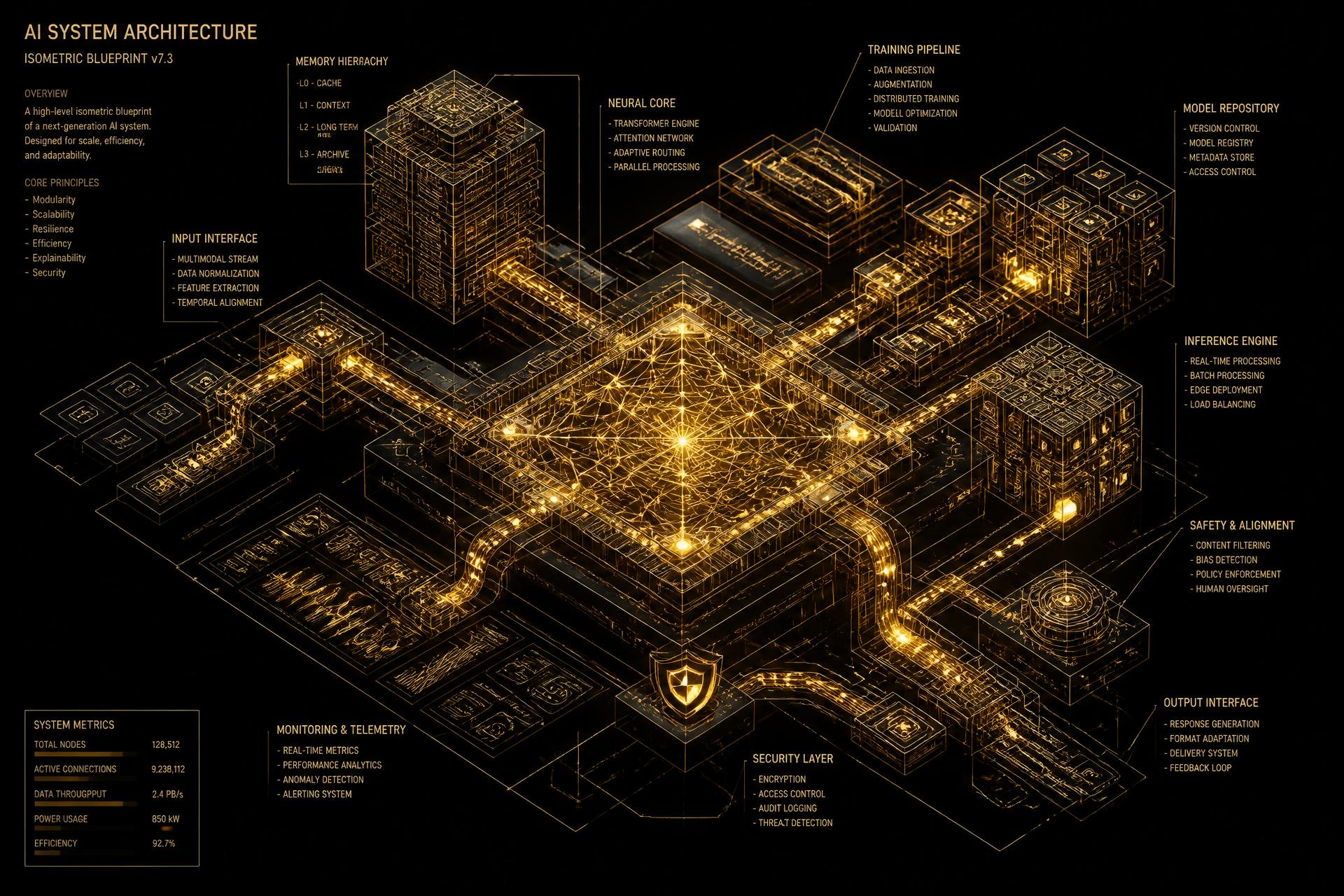
A six-layer reference for AI-native platforms. Not a framework. Not a stack diagram on a slide. The actual order of operations behind every product Itai Varochik ships.
Most AI products are demos in a trench coat. They impress for a week, then collapse the first time a real workflow touches them. This document is the opposite. It is the architecture I reach for when the goal is a platform that still works in eighteen months, with a customer paying real money and a regulator paying attention.
Six layers, in order. Each one earns its place. Skip a layer and you will spend the next quarter rebuilding it under pressure, which is the most expensive way to build anything.

In order.
Always.
The layers are not a checklist. They are a dependency graph. The intelligence layer cannot be correct if the data plane is wrong. The growth layer cannot compound if the surface is unusable. Every shortcut you take at a lower layer is paid back, with interest, two layers up.
Substrate
The foundation. Identity, billing, RBAC, audit logging, observability. Boring on purpose, invisible by design. Every platform we ship inherits this layer pre-built so day one feels like month six.
- Postgres + RLS
- Edge runtime
- Audit-grade logs
- SOC-ready primitives
Data plane
Typed schemas, deterministic migrations, event streams. The data plane is where AI either earns its keep or hallucinates expensive nonsense. We treat schema as product.
- Typed contracts
- Event sourcing
- Vector + relational
- Backfill safe
Intelligence
Models, prompts, retrieval, evals. Not a chatbot bolted on, but inference woven through workflows where it changes a number on the P&L. Every prompt is versioned. Every eval is committed.
- Multi-model routing
- RAG with citations
- Offline evals
- Cost ceilings
Workflow
The orchestrator. Long-running jobs, retries, human-in-the-loop handoffs, idempotent side effects. The boring middleware that turns demos into systems people trust on Monday morning.
- Durable execution
- Idempotency keys
- Approval gates
- Replayable runs
Surface
The product. Operator consoles, customer apps, embedded experiences. Designed for the person actually using it at 4pm on a Thursday, not the screenshot in the deck.
- Server components
- Real-time UX
- Accessible by default
- Native feel
Growth loops
Attribution, lifecycle, referral mechanics, pricing experiments. The layer that decides whether the thing compounds or decays the moment the launch tweet stops.
- First-party events
- Cohort retention
- Pricing tests
- LTV instrumentation
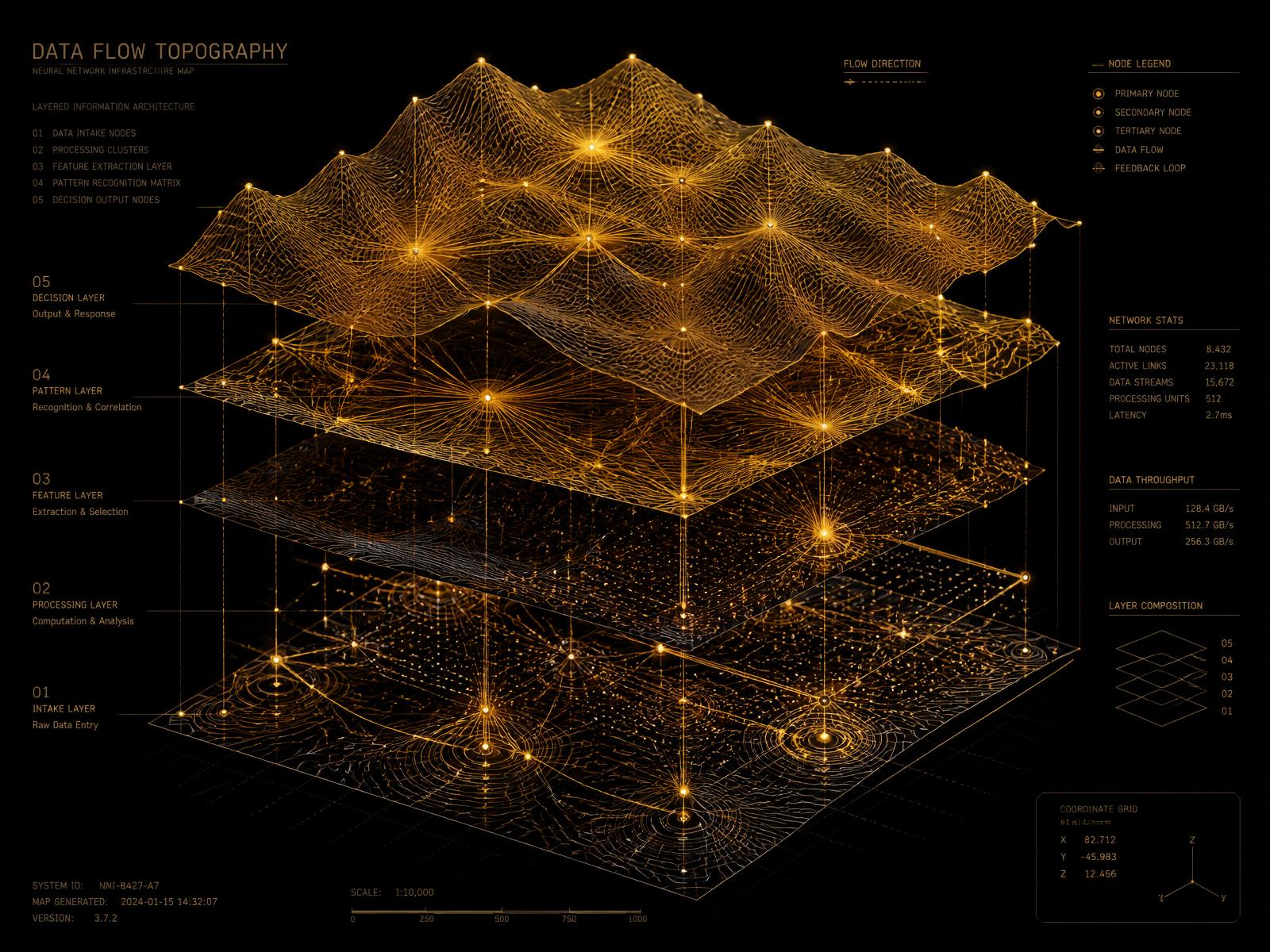
Five planes,
one flow.
Data enters at the intake plane and flows up through processing, feature extraction, pattern recognition, and finally a decision surface. The same flow runs in reverse for feedback. Every plane has its own latency budget. Every plane has its own failure mode. You cannot debug a system you cannot draw.
Six laws that
survive the demo.
Schema is product
If the data model is wrong, everything downstream is theater. Get this right before anything ships.
Inference inside workflows
AI on the marketing page is a demo. AI inside a workflow that changes unit economics is a business.
Determinism where it matters
Money, identity, audit trails: deterministic. Creative surfaces: probabilistic. Never the inverse.
Evals as a deployment gate
If you can't measure it offline, you can't ship it. Evals are tests. Tests block deploys.
Human-in-the-loop by default
The fastest way to ship AI safely is to keep a human in the path until the metric says otherwise.
Cost ceilings as code
Every model call has a budget. Budgets are enforced by the platform, not by hope.

One object.
Many products.
The blueprint exists so that every new platform begins at month six instead of week one. The substrate is the same. The data plane is the same. The eval scaffolding, the observability, the billing, the access control: all of it ships pre-wired.
What changes is the intelligence and the surface. That is where the product lives. That is where the IP accumulates. Everything else is paid infrastructure that the next platform inherits for free.
Ninety days,
in five moves.
- Phase 00Week 0 - 1
Substrate online
Identity, billing, RBAC, audit, observability. Day-one parity with a year-old SaaS.
- Phase 01Week 1 - 3
Data plane sealed
Schema, migrations, event contracts. Nothing ships until the model is right.
- Phase 02Week 3 - 6
Intelligence wired in
Models, prompts, retrieval, evals. Cost ceilings enforced before the first paying user.
- Phase 03Week 6 - 9
Workflow + surface
The actual product people log into. Real users. Real money. Real metrics.
- Phase 04Week 9 - 12
Growth loops live
Attribution, lifecycle, pricing experiments. The compounding starts here.
The blueprint is not the product. The product is the thing customers can't live without. The blueprint is what makes it cheap to find that product, fast to ship it, and durable enough to keep when you do.
— Itai Varochik · Tel Aviv · Operating worldwide